Selecting a school requires more than comparing fees, rankings and infrastructure. Parents exploring the best CBSE schools in North Bangalore should understand what the curriculum covers, how the school delivers it and whether the learning environment suits their child.

What Parents in North Bangalore Should Know Before Choosing a School
Choosing the right school in North Bangalore requires parents to look beyond location and fees and consider the complete learning environment offered to their child. Important factors include the school’s curriculum, academic standards, teacher quality, student safety, infrastructure, co-curricular opportunities, and approach to holistic development. Parents should also understand how the school supports individual learning needs, encourages communication and critical thinking, and prepares students for future academic and career pathways. Visiting the campus, interacting with teachers, reviewing school policies, and understanding the school’s values can help families make a more informed decision that aligns with their child’s interests, abilities, and long-term growth.
What Is the CBSE Curriculum?
The CBSE syllabus provides a structured academic framework covering subjects, learning objectives, teaching guidelines and assessment methods. It aims to build conceptual understanding, practical knowledge and age-appropriate competencies.
Understanding the Role of CBSE and NCERT
The Central Board of Secondary Education determines academic standards, assessment schemes and board examination requirements. NCERT develops national curriculum frameworks, textbooks and learning resources that many CBSE school’s use.
How the CBSE Curriculum Is Structured Across School Stages
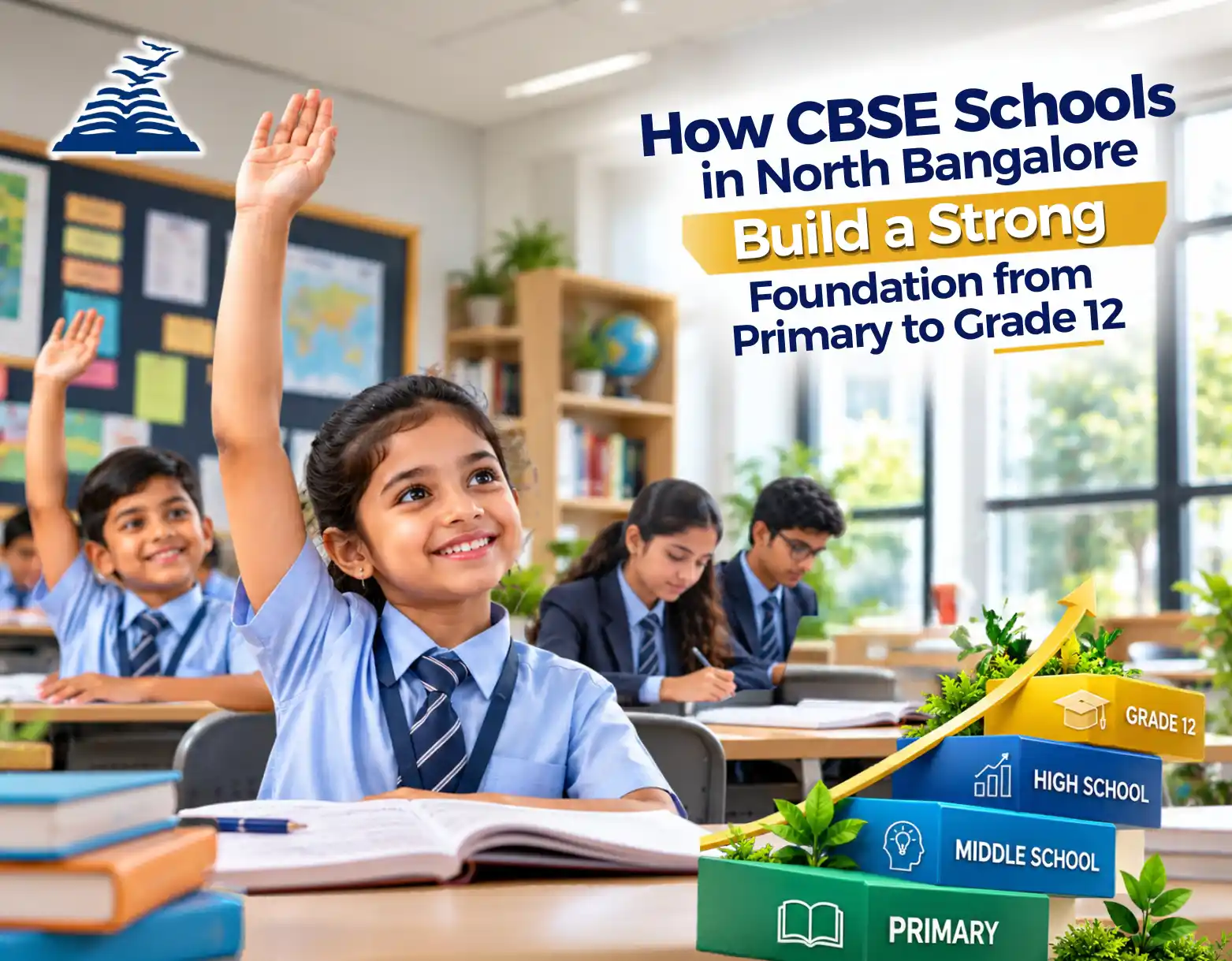
The current framework follows a developmental progression across foundational, preparatory, middle and secondary stages, with Classes 11 and 12 forming the senior secondary phase.
Foundational Stage: Learning Through Play and Exploration
The foundational stage uses stories, games, conversations, movement and hands-on activities to develop early literacy, numeracy, motor abilities and social confidence.
Preparatory Stage: Building Core Academic Skills
During Classes 3 to 5, students strengthen reading, writing, mathematics and environmental awareness through activity-based lessons and classroom participation.
Middle Stage: Developing Conceptual and Critical Thinking
Classes 6 to 8 introduce more specialised subjects, experiments, projects and discussions that encourage students to analyse information and connect ideas.
Secondary Stage: Preparing for Board Examinations
Classes 9 and 10 require students to deepen subject knowledge, practise application-based questions and prepare systematically for the Class 10 board examination.
Senior Secondary Stage: Choosing Subjects for Future Careers
In Classes 11 and 12, students select subjects aligned with interests, higher-education plans and career aspirations.
Key Features of the CBSE Curriculum
The curriculum increasingly emphasises competencies, flexibility, interdisciplinary connections and the practical use of knowledge rather than memorisation alone.
Competency-Based and Experiential Learning
Experiments, case studies, projects and real-life tasks help students demonstrate what they can do with the concepts they have learned.
Focus on Conceptual Understanding and Practical Application
Teachers are encouraged to explain why a concept works and provide opportunities for students to apply it in unfamiliar situations.
Integration of Technology, Artificial Intelligence and Skill Education
CBSE’s evolving curriculum increasingly incorporates computational thinking, artificial intelligence and skill-based learning opportunities.
Development of Communication, Creativity and Problem-Solving Skills
Presentations, group work, research tasks and classroom discussions help learners’ express ideas, consider alternatives and solve problems independently.
Subjects Offered in CBSE Schools
Subject availability may differ between institutions, so parents should review the school’s current academic programme before admission.
Core Subjects in Primary and Middle School
Students generally study languages, mathematics, environmental studies, science and social science, supported by arts, physical education and skill-based learning.
Subject Choices in Classes 9 and 10
Along with compulsory academic areas, schools may offer optional languages, skill subjects or technology-related courses based on available resources.
Science, Commerce and Humanities Options in Classes 11 and 12
Senior secondary combinations can include subjects from science, commerce, humanities, languages and skill education, depending on the school.
How Students Are Assessed Under the CBSE Curriculum
Assessment is designed to monitor subject understanding, application, participation and progress throughout the academic year.
Periodic Tests, Projects and Internal Assessments
Schools use written tests, portfolios, projects, practical work and subject-enrichment activities to evaluate different aspects of learning.
Competency-Based Questions and Board Examinations
Board examinations include questions that test interpretation, reasoning and application in addition to knowledge and recall.
Benefits of Choosing the CBSE Curriculum for Your Child
Families considering CBSE schools in Yelahanka may find the curriculum suitable when they want a nationally recognised framework with structured academic progression.
Nationally Consistent Curriculum for Families Who Relocate
A broadly consistent framework can make transitions easier for children whose families move between cities or states.
Strong Foundation for Competitive Examinations
The emphasis on mathematics, science and conceptual clarity can support students preparing for national entrance examinations, although separate preparation may still be necessary.
Balanced Focus on Academics and Holistic Development
A well-implemented programme combines classroom learning with physical activity, creativity, values and personal development.
How Schools Go Beyond the Prescribed CBSE Curriculum
The CBSE board establishes academic expectations, but each school determines how effectively those expectations are translated into daily learning experiences.
Sports, Arts and Extracurricular Programmes
Team games, athletics, music, dance, theatre, art and clubs allow students to discover interests while building confidence and discipline.
Life Skills, Values and Social-Emotional Learning
Age-appropriate programmes can teach empathy, collaboration, self-awareness, responsible behaviour and healthy ways of managing emotions.
Career Guidance and Future-Ready Learning Opportunities
Career counselling, industry interactions, coding, entrepreneurship and leadership programmes can help older students make informed decisions.
What Parents in North Bangalore Should Evaluate Before Choosing a CBSE School
The best school in Yelahanka for a particular child will be one that matches the learner’s needs, interests, temperament and daily routine.
Verify the School’s Official CBSE Affiliation
Parents should confirm the school’s name, affiliation number and current status through the official website.
Understand How the School Implements the Curriculum
Ask whether lessons involve discussion, investigation and application or depend mainly on textbooks, worksheets and memorised answers.
Evaluate Teacher Quality and Classroom Practices
Observe whether teachers explain concepts clearly, encourage questions and provide constructive feedback.
Review Academic Support and Individual Attention
Find out how the school identifies learning gaps and supports students who require reinforcement or additional challenges.
Assess Infrastructure, Laboratories and Technology
Check whether laboratories, libraries, sports areas and digital resources are safe, functional and regularly used.
Examine Student Safety, Well-Being and Counselling Support
Review safeguarding procedures, transport protocols, anti-bullying measures, medical support and access to trained counsellors.
Consider Location, Transport and Daily Travel Time
A manageable commute can give children more time for sleep, play, homework and family interaction.
Questions to Ask During a CBSE School Campus Visit
Parents comparing CBSE-affiliated schools can ask:
- How are lessons made experiential?
- What is the typical class size?
- How is student progress communicated?
- Which subjects and activities are available?
- What academic and emotional support is provided?
Red Flags Parents Should Notice Before Admission
Warning signs include unclear affiliation details, overcrowded classrooms, limited teacher interaction, poorly maintained facilities, excessive academic pressure and reluctance to explain safety policies.
Is the CBSE Curriculum the Right Choice for Your Child?
CBSE can suit students who benefit from structured learning, national consistency and concept-based preparation. The final decision, however, should consider the child’s learning style and the school’s ability to implement the curriculum meaningfully.
Choosing a CBSE School That Matches Your Child’s Learning Needs
For parents exploring schools in North Bangalore, understanding the CBSE curriculum is an important part of making the right choice. At Presidency School Bangalore North, the curriculum is supported by a learning environment that encourages conceptual understanding, application-based thinking, communication, creativity, and consistent academic progress. Beyond textbooks, students engage in projects, discussions, practical activities, sports, and co-curricular experiences that help them connect learning with real-life situations. With experienced educators, structured academic support, and a strong focus on holistic development, Presidency School Bangalore North offers families a balanced CBSE education that prepares students to face higher studies, competitive pathways, and future opportunities with confidence.
Conclusion
Understanding the CBSE curriculum gives parents a clearer basis for choosing a school, but the curriculum alone does not determine the quality of a child’s education. What matters equally is how well the school brings it to life through capable teachers, experiential learning, academic support, technology, co-curricular opportunities, safety, and student well-being. For families exploring the best CBSE schools in North Bangalore, a campus visit should go beyond infrastructure and focus on classroom practices, teacher interaction, assessment methods, subject choices, and the overall learning environment. When the curriculum, school culture, and a child’s individual needs align well, CBSE can provide a strong foundation for academic progress, future studies, and confident personal growth.