Ask ten toppers what they remember most fondly about school, and barely any of them will mention a chapter test. They’ll talk about the debate they almost lost, the play they forgot their lines in, or the robotics project that blew a fuse three times before it finally worked. Grades measure what a student has memorised; the activities around them shape who that student actually becomes.
This guide breaks down exactly which activities are worth a student’s time, why they matter, and how to pick ones that fit — without turning the calendar into a battlefield.
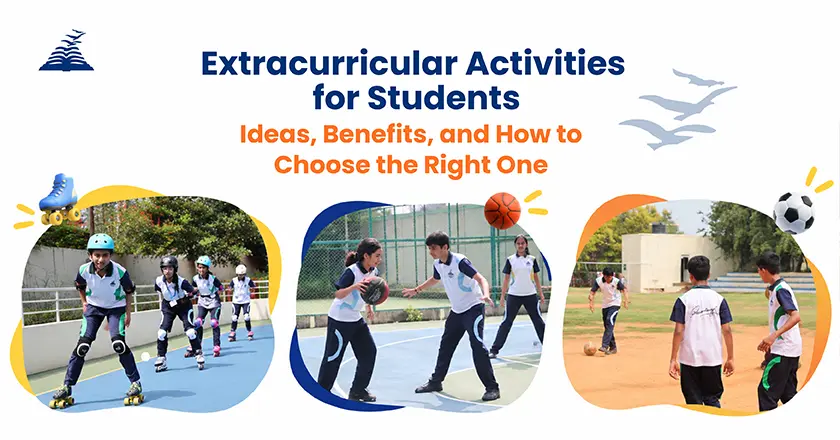
Table of Contents
What Are Extracurricular Activities?
In the simplest terms, extracurricular activities for students are structured pursuits — sports, music, debate, coding, art — that happen outside the regular academic timetable, usually by choice rather than requirement. They’re where a student gets to apply, rather than just absorb, whatever the classroom has been teaching.
A quick distinction worth making here is co-curricular vs extracurricular activities — the two get used interchangeably, but they aren’t quite the same thing. Co-curricular activities sit closer to the syllabus (a science exhibition, an elocution round tied to the language paper), while pure extracurricular — a football league, a dance troupe — exist entirely outside it. The line matters less in practice than the outcome: both build skills a mark sheet never captures.
| Co-curricular Activities | Extracurricular Activities |
| Linked to the syllabus (science fairs, elocution) | Independent of the syllabus (sports, music, clubs) |
| Often assessed or graded | Rarely graded, chosen freely |
| Reinforce classroom learning | Build separate life skills |
Why Are Extracurricular Activities Important for Students?
The importance of extracurricular activities for students goes well beyond keeping them busy after the bell rings. These pursuits are where students first practise handling pressure, disappointment, and deadlines in a low-stakes setting — long before a job or a university does it for them at a much higher cost of failure. A student who’s learned to bounce back after losing a debate round handles a bad exam result very differently than one who’s never faced that kind of setback outside a classroom.
Best Extracurricular Activities for Students
Here are fifteen activities worth considering, spanning every interest from the sporty to the studious:
1. Sports and Physical Activities
Football, athletics, swimming, badminton — anything that gets the body moving builds fitness, discipline, and a healthy relationship with both winning and losing.
Also Read: Sports at Presidency School Bangalore North: Developing Skills Beyond the Classroom
2. Music and Instrument Learning
Piano, guitar, tabla, vocals — regular practice sharpens focus and pattern recognition far more than most people give it credit for.
3. Dance and Performing Arts
Beyond fitness and rhythm, dance builds a comfort with being watched — genuinely useful for presentations and interviews years down the line.
4. Art and Craft Activities
Drawing, painting, and hands-on craft projects give students a non-verbal outlet for ideas and emotions that words don’t always capture well.
5. Debate and Public Speaking
Few activities build argument structure and quick thinking as fast as standing up and defending a position in front of an audience.
6. Drama and Theatre
Acting forces empathy — stepping into someone else’s perspective for two hours teaches more about people than most textbooks manage.
7. Coding and Robotics
Writing a first script or assembling a working robot teaches structured problem-solving, one small, debuggable step at a time.
8. Science and STEM Clubs
Hands-on experiments and STEM projects turn abstract formulas into something a student can actually see, measure, and sometimes accidentally break.
9. Reading and Creative Writing
A student who writes regularly — stories, journal entries, even fan-fiction — builds vocabulary and argument skills that quietly show up in every subject.
10. Chess and Strategy Games
Chess and similar games sharpen planning and patience in a way that rarely feels like effort, which is exactly why it works.
11. Community Service and Volunteering
Volunteering exposes students to realities beyond their own — a lesson in perspective that no classroom discussion can fully replicate.
12. Gardening and Environmental Activities
Tending a school garden or joining an eco-club teaches patience and responsibility on a timeline nothing digital ever will.
13. Photography and Digital Media
Photography and basic video editing teach students to notice detail and tell a story visually — a genuinely modern, transferable skill.
14. Entrepreneurship and Business Clubs
Running a small school stall or student-led venture teaches budgeting, pitching, and handling rejection — real preparation for the working world.
15. Quiz and General Knowledge Clubs
Quizzing builds a habit of staying curious about the world, well beyond whatever’s strictly on the syllabus that term.
Benefits of Extracurricular Activities for Students
The benefits of extracurricular activities show up in places you wouldn’t expect — not just on stage or the field, but in the classroom too.
Improves Academic Performance
Contrary to the fear that activities eat into study time, students with a structured hobby often manage their study hours better, not worse.
Builds Confidence and Self-Esteem
Mastering a skill outside class — a song, a serve, a speech — gives students proof that consistent effort actually pays off.
Develops Leadership and Teamwork Skills
Someone has to captain the team or direct the group project; activities naturally rotate students through leading and following roles.
Improves Communication and Social Skills
Group activities force students to negotiate and collaborate with peers they didn’t choose — a skill no lecture can substitute for.
Encourages Creativity and Critical Thinking
Open-ended pursuits like art or robotics exercise original thinking in a way that fill-in-the-blank worksheets simply can’t.
Supports Physical and Emotional Well-Being
Physical activities burn off restlessness, while creative ones process emotions students haven’t yet learned to put into words.
Helps Students Discover Their Interests and Talents
Many students only discover what they’re genuinely good at — or love — by trying something with zero academic pressure attached.
Develops Time Management and Discipline
Juggling practice, homework, and rest teaches scheduling skills far earlier than most students would otherwise learn them.
Also Read : Why Extracurricular Activities Are Key to a Child’s Overall Growth
Types of Extracurricular Activities for Students
Broadly, the types of extracurricular activities available in most schools fall into five categories:
Academic Activities
Quiz clubs, Olympiads, and academic societies extend classroom learning into competitive, self-directed territory.
Sports and Fitness Activities
Team sports, athletics, and fitness clubs build physical health alongside discipline and teamwork.
Creative and Performing Arts
Music, dance, drama, and visual art give students a structured outlet for imagination.
Technology and STEM Activities
Coding clubs, robotics teams, and science fairs build problem-solving skills for an increasingly technical world.
Leadership and Community Activities
Student councils, volunteering programs, and entrepreneurship clubs build responsibility and real-world decision-making.
Extracurricular Activities for Different Age Groups
What works for a ten-year-old rarely works for a seventeen-year-old. Here’s a quick comparison:
| Age Group | Suitable Activities |
| Primary school | Art, music, basic sports, storytelling, simple clubs |
| Middle school | Debate, robotics, team sports, drama, creative writing |
| High school | Leadership roles, advanced sports, entrepreneurship, research projects, competitive quizzing |
Activities for Primary School Students
At this stage, short, playful sessions work best — the goal is exposure and enjoyment, not mastery or competition.
Activities for Middle School Students
Pre-teens are ready for slightly more structure and challenge, making this a good age to introduce clubs and team-based activities.
Activities for High School Students
Teenagers benefit from activities with real responsibility attached — leadership positions, competitions, and projects that feel genuinely purposeful.
How to Choose the Right Extracurricular Activity
A few honest questions make this decision far easier than any ranked list of “best” activities.
Consider the Student’s Interests
Notice what a student chooses to do with genuinely free time — that’s a far better signal than any trend or peer pressure.
Identify Strengths and Areas for Growth
An activity that stretches a weaker skill can matter just as much as one that showcases an existing strength.
Choose Age-Appropriate Activities
Match the complexity, duration, and intensity of an activity to what a student can realistically sustain without burning out.
Consider Time and Academic Commitments
Check the school calendar and exam schedule before committing — an activity that clashes with revision time rarely survives the term.
Encourage Students to Explore New Activities
Let students try something unfamiliar occasionally; some of the best-loved hobbies started as a reluctant, last-minute sign-up.
Avoid Overscheduling
Two activities a student genuinely enjoys will always beat five that leave them constantly exhausted and resentful.
How Many Extracurricular Activities Should a Student Join?
Most educators agree that two to three well-chosen activities are the sweet spot for a typical school-going student — enough to build real skill without crowding out academics or rest. The right amount of extracurricular activities in schools also depends heavily on the student’s grade level; a ten-year-old can usually handle more variety than a seventeen-year-old juggling board exams and college applications. When in doubt, quality of engagement matters far more than the number of activities listed on a resume.
How to Balance Academics and Extracurricular Activities
Balance doesn’t happen by accident — it needs a bit of deliberate planning.
Create a Realistic Weekly Schedule
Block out fixed hours for both study and activities on a single calendar, so neither one silently eats into the other.
Prioritise Schoolwork and Important Tasks
During exam weeks, it’s fine to scale activities back temporarily rather than trying to do everything at full intensity.
Avoid Taking on Too Many Activities
Committing to fewer activities, done well, builds more genuine skill than spreading thin across everything on offer.
Make Time for Rest and Recreation
Unstructured downtime isn’t wasted time — it’s often when a student actually processes and consolidates everything they’ve learned.
How Parents Can Support Their Child’s Extracurricular Interests
Support looks less like enrolling a child in every available class and more like showing genuine interest in the one they’ve already chosen. Ask about practice, attend a performance or match when possible, and resist comparing progress to a sibling’s or classmate’s pace. Many parents shortlisting the best CBSE schools in Bangalore North specifically look for institutions that keep families involved through regular activity showcases and parent-teacher check-ins on non-academic progress too — it’s often a good sign of how seriously a school takes this side of a child’s development.
How Extracurricular Activities Help Build Future-Ready Skills
Employers today look well beyond a transcript — communication, adaptability, and teamwork now matter as much as technical knowledge, and extracurriculars are where students first practise all three. This is increasingly reflected in how schools structure their programs: several of the top CBSE schools in Yelahanka now treat activity participation as part of a student’s holistic profile rather than an optional add-on, recognising that the skills built on a stage, a field, or a coding club often matter more in the long run than one extra mark on a test.
Presidency School Bangalore North: Helping Students Discover the Right Activities for Their Growth
Choosing the right extracurricular activities for students is about finding experiences that match a child’s interests, strengths, personality, and developmental needs. At Presidency School Bangalore North, students are encouraged to explore a wide range of opportunities across sports, arts, music, dance, theatre, coding, debate, leadership, and creative clubs, allowing them to discover what they genuinely enjoy. Participation in these activities helps build confidence, teamwork, communication, discipline, creativity, and problem-solving skills while offering a healthy balance to academic learning. With guidance from teachers and opportunities to try different pursuits, Presidency School Bangalore North helps students make meaningful choices that support their overall growth and bring out their individual potential.
Conclusion
Extracurricular activities give students a valuable space to discover interests, test abilities and build skills that traditional classroom learning may not always develop fully. Whether through sports, music, debate, coding, art, volunteering or leadership, these experiences strengthen confidence, communication, creativity, teamwork, discipline and resilience. The key is to choose activities that match the student’s age, interests and available time rather than filling every free hour. Parents and schools can support this growth by encouraging exploration, avoiding unnecessary pressure and maintaining a healthy balance with academics and rest. When students participate consistently in activities they genuinely enjoy, extracurricular learning becomes an important foundation for future-ready skills and well-rounded personal development.