When parents begin researching school options for their children, one question surfaces almost immediately which curriculum will actually serve my child well? Not just for the next grade, or the next examination, but for the years of learning, growth, and opportunity that follow. The CBSE syllabus has earned its position as India’s most widely trusted school curriculum not through marketing but through consistent delivery. It is structured, progressive, nationally recognised, and designed with a clarity of educational purpose that parents, teachers, and students can all rely on.
Understanding what makes it genuinely comprehensive and what that comprehensiveness actually means for a child’s education is worth examining carefully.
What Makes the CBSE Syllabus Comprehensive and Well-Structured
The syllabus is comprehensive because it addresses multiple dimensions of learning simultaneously: subject knowledge, conceptual understanding, skill development, values education, and practical application. It does not treat academics as the only thing that matters, nor does it allow holistic development to become an excuse for academic inadequacy. At every top school in Bangalore affiliated with CBSE, this comprehensiveness shows up in how the school day is structured time for core academics, time for experiential learning, time for physical development, and time for creative expression, all given deliberate space within the overall curriculum framework.
A Curriculum Designed for Progressive Learning Across Grades
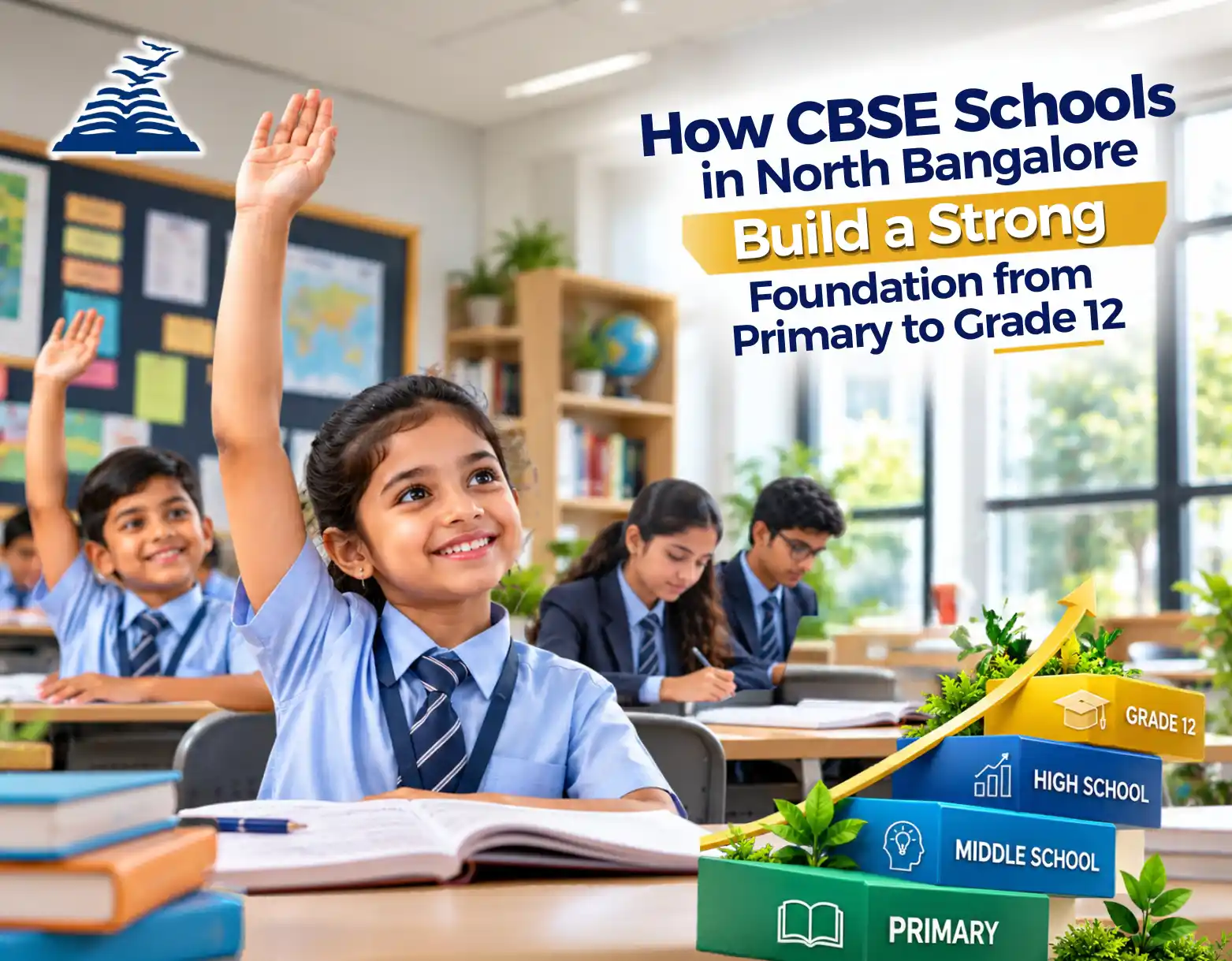
The CBSE syllabus is built on a principle that sounds simple but is rarely executed well in practice each year of learning should build meaningfully on the year before. Concepts are introduced at the appropriate developmental stage, revisited with increasing complexity across subsequent grades, and consolidated before new material builds upon them. At the top 10 CBSE schools in Bangalore, teachers understand and actively apply this progression.
Building Strong Foundations Through Concept-Based Education
CBSE’s syllabus is explicitly designed around concept-based education. At good CBSE schools in Bangalore, the difference shows up in daily instruction teachers who ask why and how rather than only what, examinations that require application rather than recall, and classroom cultures that treat genuine understanding as the standard rather than the exception.
Balanced Focus on Core Subjects, Skills, and Values
A truly comprehensive syllabus addresses three dimensions that are sometimes treated as separate but are most effectively developed together academic content, practical skills, and personal values. CBSE integrates all three across its curriculum:
- Core Academic Subjects across Languages, Mathematics, Science, and Social Studies form the intellectual foundation of the syllabus developed progressively and assessed rigorously.
- Skill Development through work education, computer science, health and physical education, and art education ensures students develop practical capabilities alongside theoretical knowledge.
- Values Education embedded across the curriculum through literature choices, history content, civic education, and community service components builds the ethical awareness and social responsibility that academic knowledge alone cannot provide.
At top schools in Bangalore that implement all three dimensions with equal seriousness, students graduate not just academically capable but practically skilled and personally grounded the combination that genuinely prepares a person for adult life.
How CBSE Promotes Analytical and Application-Oriented Learning
The evolution of CBSE’s examination framework over recent years reflects a clear and deliberate shift away from questions that reward memorisation and towards questions that reward thinking. At the best CBSE School in North Bangalore, this shift in examination philosophy drives a corresponding shift in classroom instruction.
Student-Friendly Assessment and Academic Progress Monitoring
CBSE’s Continuous and Comprehensive Evaluation system was designed with a specific insight that a single high-stakes annual examination is a poor and unfair measure of a student’s actual learning and capability. Real academic progress is uneven, multi-dimensional, and best understood through multiple data points gathered across the year.
The CBSE Framework Addresses This Through
Formative Assessments
Regular quizzes, class participation, projects, and oral evaluations conducted throughout the term.
Summative Assessments
Periodic examinations that assess cumulative learning at key points in the academic year.
Practical & Project Work
Evaluated separately to capture learning that written examinations cannot effectively measure.
Co-Scholastic Assessment
Formal recognition of participation in sports, arts, and community activities.
At best schools in Bangalore that implement CBSE syllabus seriously rather than perfunctorily, this framework provides teachers with the ongoing performance data they need to intervene early when students are struggling rather than discovering gaps only at year-end when they have had months to compound.
Supporting Consistency and Continuity in School Education
India is a country of significant internal migration families relocate between cities for professional reasons with a frequency that makes curriculum consistency a genuinely practical concern. CBSE’s national standardisation makes this continuity possible. The syllabus, examination patterns, and academic expectations remain consistent regardless of which city a student is in or which CBSE school they attend. For parents at affordable CBSE schools in Bangalore who may face relocation possibilities, this continuity is not a minor benefit it is a significant protection for their child’s academic momentum and emotional security during what is often an already disruptive transition.
Alignment with National-Level Competitive Examinations
The practical alignment between CBSE’s curriculum and India’s major competitive entrance examinations is one of the most tangible and frequently cited advantages of the board. IIT-JEE, NEET, CUET, NDA, and numerous other national-level examinations are designed with CBSE’s syllabus as their primary reference framework.
| Competitive Exam | Relevant CBSE Subjects | Curriculum Overlap |
|---|---|---|
| JEE Main & Advanced | Physics, Chemistry, Maths | Very High |
| NEET-UG | Physics, Chemistry, Biology | Very High |
| CUET | Multiple + General Aptitude | High |
| NDA | Mathematics, General Studies | High |
| Olympiads | Science, Mathematics | High |
At primary schools in Bangalore following CBSE, this alignment begins building its advantage from the foundational years not through premature competitive preparation, but through the development of conceptual depth in core subjects that competitive examinations will eventually test.
Encouraging Holistic Growth Beyond Academic Performance
The CBSE syllabus formally and explicitly recognises that education must serve the whole child. Sports, physical education, art, music, theatre, and community service are not optional enrichment activities in a genuinely implemented CBSE programme they are integral components of what the board considers a complete education. At top kindergarten schools in Bangalore through to senior secondary level, schools that honour this dimension of the CBSE framework produce students who are emotionally resilient, physically active, creatively capable, and socially engaged alongside being academically strong.
Preparing Students for Higher Education and Career Pathways
The CBSE syllabus prepares students for higher education not merely by covering content that degree programmes build upon, but by developing the academic capabilities independent study, conceptual reasoning, structured written communication, and research orientation that higher education demands.
Understanding the Comprehensive CBSE Syllabus and Its Remarkable Benefits at Presidency School Bangalore North
The CBSE syllabus is widely recognized as one of India’s most comprehensive, progressive, and future-oriented academic frameworks, and Presidency School Bangalore North has distinguished itself as an institution that delivers this powerful curriculum with exceptional depth, expertise, and transformative impact across all grade levels.
At Presidency School Bangalore North, the CBSE syllabus is implemented far beyond mere textbook instruction, with visionary educators unpacking every subject’s full potential through conceptual exploration, real-world application, interdisciplinary connections, and continuous skill-building exercises that make learning genuinely meaningful and lastingly impactful for every student.
The curriculum’s inherent strengths including its structured progression, emphasis on analytical reasoning, science and mathematics rigor, language development, and social science awareness are all maximized through Presidency School Bangalore North’s innovative pedagogical approach that consistently brings out the very best in each learner.
Conclusion
The CBSE syllabus endures as India’s most trusted school curriculum because it consistently delivers on what parents, students, and educators need most a structured, progressive, and genuinely comprehensive framework that prepares children for academic success, competitive examinations, and meaningful adult life.
Its strength lies not in any single feature but in how its elements work together: concept-based learning that builds durable understanding, continuous assessment that supports early intervention, competitive exam alignment that maximises student opportunity, and holistic development that shapes well-rounded individuals rather than purely academic performers.
For parents in Bangalore evaluating school options, the question is not simply whether to choose CBSE it is whether the school they choose truly brings the CBSE framework to life with the commitment and quality it deserves. When that commitment exists, the curriculum becomes more than a syllabus. It becomes a foundation one strong enough to support a child’s growth from their first classroom all the way through to the opportunities and challenges of a purposeful, well-prepared life.