Understanding the Word Computer: Meaning, History, and Uses
Many students search for Computer Full Form because they are curious to know what each letter in the word “computer” stands for. However, it is important to understand that the word computer is not officially an acronym. It comes from the word “compute,” which means to calculate or process information. Over time, computers have evolved from simple calculating machines into powerful devices used for learning, communication, creativity, research, and problem-solving. Still, schools often teach a popular full form of computer to help students easily remember its purpose and understand how computers support daily life and education.
The Importance of Computers in Everyday Life
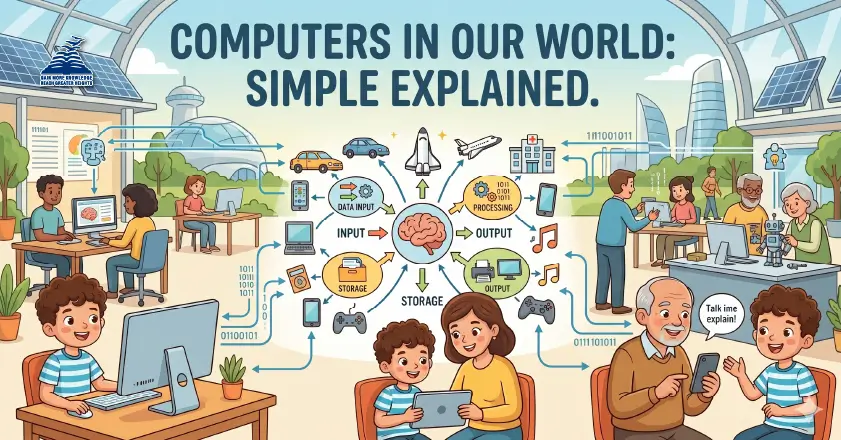
Computers have become an important part of everyday life. From classrooms and offices to homes, hospitals, banks, and shops, computers help people learn, work, create, store information, and communicate faster. In many of the best CBSE schools in Bangalore, students are introduced to computers at an early age so they can build strong digital skills and understand technology with confidence.
What is Computer?
A computer is an electronic machine that accepts data, processes it, stores information, and gives useful output. When we type on a keyboard, click with a mouse, watch a video, or solve a maths problem using software, the computer is following instructions. It does not think like a human, but it can perform tasks very quickly and accurately when the right commands are given.
Understanding the Meaning of Computer
The word computer originally comes from the idea of “computing,” which means calculating. Earlier, computers were mainly used for mathematical calculations. Today, they are used for many more activities such as writing, designing, learning, researching, coding, gaming, communication, and data management. This makes computers useful for both students and adults.
Commonly Used Full Form of Computer
The commonly used full form of computer is “Common Operating Machine Particularly Used for Technical Education and Research.” This full form is not official, but it is widely used for educational understanding. It explains that a computer is a useful machine that supports technical work, learning, research, and many other important tasks.
Simple Definition of Computer for Students
A simple Computer Definition for students is this: a computer is an electronic device that takes input, processes it, stores data, and produces output. For example, when a student types an essay, the keyboard gives input, the CPU processes it, the monitor displays the output, and the file can be saved in storage.
How Computers Help in Daily Life
The Uses of Computer can be seen in almost every part of daily life. Students use computers for learning, projects, presentations, online classes, and research. Parents use them for banking, shopping, communication, and office work. Doctors use computers to store patient records, while businesses use them for accounts, data, and planning.
Basic Parts of a Computer
A computer has different parts that work together. Each part has a specific role in helping the computer function properly.
| Computer Part | Main Function |
| Monitor | Displays text, images, videos, and output |
| Keyboard | Helps type letters, numbers, and commands |
| Mouse | Helps select, click, and move items on screen |
| CPU | Processes instructions and acts as the brain |
| Speakers | Produce sound |
| Printer | Prints documents and images |
| Storage Device-(Hard disks, pen drives, DVDs etc) | Saves files, photos, videos, and data |
Different Types of Computers Explained Simply
The History of Computers shows how computers changed from large calculating machines to small and powerful devices. Today, there are different types of computers such as desktops, laptops, tablets, servers, and supercomputers. A desktop is often used at home or school, while a laptop is portable. Supercomputers are used for advanced research, weather forecasting, and scientific calculations.
Importance of Computers in Education
The Importance of Computer in education has grown greatly over the years. Computers help students understand lessons through videos, animations, digital textbooks, quizzes, and educational games. Teachers can also use computers to prepare worksheets, presentations, assignments, and assessments. This makes learning more interactive and interesting.
How Computers Support Learning and Creativity
The Advantages of Computers are not limited to speed and storage. Computers also support creativity. Students can draw, design posters, write stories, prepare presentations, create videos, learn coding, and explore science projects. With the right guidance, computers become tools for imagination, expression, and problem-solving.
Common Uses of Computers at Home and School
In top CBSE schools in Bangalore, computers are often used as part of regular learning. Students may use them for computer science classes, project work, research, typing practice, coding, online tests, and smart classroom activities. At home, computers are useful for homework, reading, video calls, entertainment, and learning new skills.
Interesting Facts About Computers for Students
Computers are full of interesting facts that make learning fun. The first computers were very large and filled entire rooms. Today, a small laptop or tablet can do many tasks much faster. Computers use binary language, which is based on 0 and 1. The CPU is called the brain of the computer because it controls processing and instructions.
Why Learning About Computers Is Important Today
It is important to understand that computer knowledge is not optional in schools anymore. Students need digital skills for future education, careers, communication, and daily life. Learning about computers helps children become confident users of technology instead of only depending on others for basic digital tasks.
How Computers Build Future-Ready Skills
Computers help students develop skills that are useful for the future. These include logical thinking, creativity, typing, research ability, digital communication, problem-solving, and basic coding. When students learn how to use computers responsibly, they become better prepared for higher studies and modern careers.
Important future-ready skills include:
- Digital literacy
- Research and information skills
- Presentation skills
- Coding and logical thinking
- Creative designing
- Safe internet usage
- Online communication
- Problem-solving ability
Understanding Computers in a Simple and Meaningful Way
Understanding what a computer stands for helps students build a strong foundation in digital learning and modern technology. At Presidency School Bangalore North, students are encouraged to learn computer concepts in a simple, engaging, and practical way, starting from the basic meaning, uses, parts, and importance of computers in daily life. While “computer” is not originally a full form, it is commonly understood as a smart electronic device that processes information, solves problems, supports learning, and enhances creativity. Through technology-enabled classrooms, hands-on learning, and guided digital exposure, Presidency School Bangalore North helps students develop essential computer knowledge and future-ready skills with confidence.
Conclusion
A computer is one of the most useful inventions in modern life. Although the word computer does not have an official full form, the commonly used full form helps students understand its educational and technical purpose. Computers help us learn, communicate, create, calculate, store data, and solve problems. For students, learning about computers is important because it builds confidence, creativity, and future-ready skills. With proper guidance, computers can become powerful tools for education, innovation, and personal growth.